


“This spirit, the voice of which is reaching (into heaven) like this and is making suit, whose (spirit) is it (1 Enoch 22:6-7)?”1 The spirit is revealed to be Abel’s, pursuing a case against Cain until all of Cain’s seed is exterminated from the face of the earth, and his seed has disintegrated from among the seed of the people.
Now, in the pursuit of Justice, do we not find ourselves in the same place as Enoch, witnessing the many whose justice was deferred? Whether it is by giving mind to those who have been wronged and are living today or by calling upon the dead and the ghosts to speak now about historical wrongs that have not been addressed by their roots and stems, we can hear the voices reaching into the sky that are making suit like Job did until he received an audience with the Most High. Judgment and Justice are not always executed in one’s lifetime; wrongs are not always righted. 1 Enoch, Ecclesiastes, and the book of Job2 attest to this. The question that may present itself is whether we mortals with our eyes gazing upon the Heavens and the abode of the Most High ought to pursue godly Justice in its absence on earth. The establishment of the court of law, along with any institution founded on the notion of Justice on this Earth, can be said to serve as a medium between Heaven and Earth, doling out justice by way of concretizing what is not in being or action. This may be a heavenly pursuit in the way of doing God’s will and in engaging with repairing the world — Tikkun Olam. Scripture regularly seems to encourage the pursuit of righteousness, emphasizing the protection of the poor, the orphan, the widow, and the stranger. To do as much is to participate in Justice.
I think it well to assume that we ought to seek out the spirits awaiting justice like Abel.3 To give ear to the voiceless whose blood still cries out to the heavens. The Enochian scene in Chapter 22 presents a hauntology of justice, both to us and to Enoch. The presentation aptly arrives in the form of spirit and disembodied voices4 as Enoch is, by the aid of angels, shown what is visible from the heavens and from the perspective of angels and God. He witnesses the gathering of the spirits of the dead awaiting judgment, and Enoch effectively asks Rufael (Raphael), “For what purpose are the spirits of the dead separated from their body and gathered here?” Enoch is told of the sinners, “judgment has not been executed upon them in their lifetime.” Rufael continues to explain that this lot will not have their souls rise on the day of judgement. Resurrection is denied.
Often, I have heard or read how much Jewish literature after the Babylonian Exile and during Roman rule is apocalyptic and messianic. There are many more extant apocalyptic texts than there are books in the canonical Hebrew Bible and, later, Christian Bible. This seems to have been so in part due to what felt like an absence of Justice. The traditional Wisdom literature of both Psalms and Proverbs, as well as the Deuteronomic Code, is typically understood to convey the idea that proper action yields good results, and that blessings and curses occur in one’s lifetime. Yet, despite the good actions and fidelity of many, the Roman occupation and Jewish revolts in Israel spelled more curses for the Israelite or Jew across the empire, while the Romans appeared no more cursed for whatever atrocities they committed. While some literature continued to hold on to the idea that one eventually suffers from their wrongdoings before their death, the more apocalyptic literature, like 1 Enoch, breaks from this and supposes judgment must occur in some postponed future. Christianity, of course, enmeshed itself in this apocalyptic fervor in such a way that, if not the fervor, the idea is still carried by many — likely even more so than much contemporary Jewish thought today.
Judgement Day, forever postponed, begins to look much more like a cancelled future. As cancelled as justice was for the many who felt they experienced more injustice than justice from time immemorial to now. Such a continuous event, an unfolding of injustice, leaves traces, whether it be blood or the disembodied voices presented and interpreted to some individual as still crying out for Justice. Somewhat like irresistible Grace, one is possessed by such a voice5, haunted, and gives special attention to avoiding the perpetuation of injustice, and this person can no longer be satiated with the mollification of a foretold event in postponement — an abeyance, non-participation, of Justice. The past continues to lay claim to the present and future; the long dead are neither fully here nor there. The haunting event, with its blood and spirit, presents no clean division between past and future. Those with the eyes to see the spectral may find the earth bespeckled with blood. Those with the ears to hear the spectral may find their ears ringing with the perpetual groaning in Sheol. Whether one is consciously aware of the haunting of the justice deferred, postponed, or cancelled, the voices nonetheless continue to cry out to those with the ears to hear.
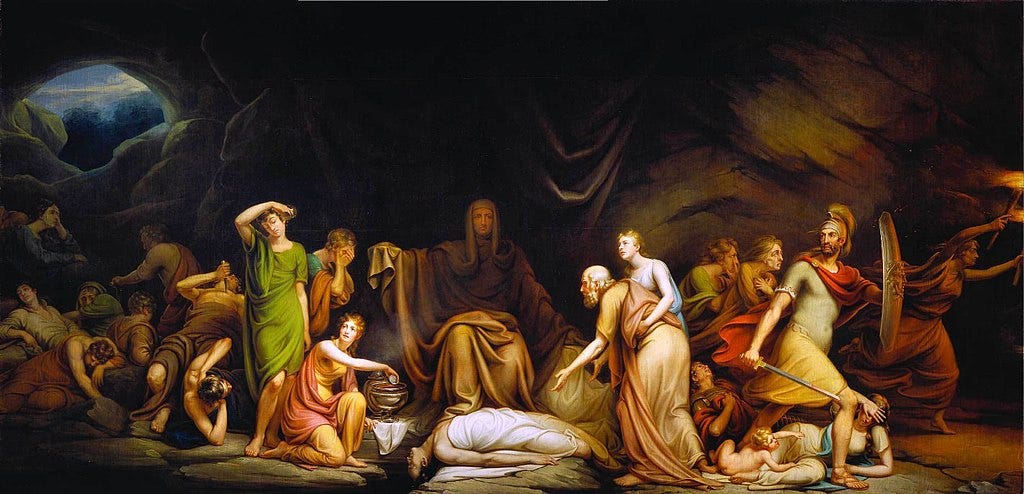
Rembrandt Peale, The Court of Death (1820)
Charlesworth, James H. The old testament pseudepigrapha 1, Apocalyptic Literature and testaments. Peabody: Hendrickson, 2020.
The Book of Job, without what seems to have been a later editor’s addition, which restores Job’s children.
I cannot help but connect the saying of Master Zeng and others in The Analects concerning the importance of making sacrifices to the dead and to the ancestors, and of establishing social harmony, which necessitates harmony between the dead and the living. To not do this is to be rootless and heedless of what has produced the current conditions one moves around in.
Blood, too, if we read the Book of Jubilees (chapter 4) into this, in which it is said that Abel’s blood cried out from the earth to heaven, making an accusation against him.
A Quaker way of putting it may be that one feels under the weight of a particular issue or, perhaps, of the Spirit.